Sunday, July 10, 2011

Time For A New Megadungeon

Alright, so it's been a couple of days since my last pst, and I've finally had a chance to cool down. I'm not completely sure what's going to happen with the blog, but the good new is that I've decided that I would definitely rather move to another hosting site than shut down.

In the mean time, I've realized that I need to create a new megadungeon. The first few levels of my current one have been explored so many times that I'm just getting a little tired of running the same surprises over and over again for different groups of players. Originally, I thought there would be something to salvage from the lower levels, but my taste has definitely changed in the past few years. Although the lost world  level, The Savage Realm of Kalgar the Scale Magician, looks pretty cool still, I've decided to start from a blank slate and work down from there.

Luckily, I have plenty of resources to work with.

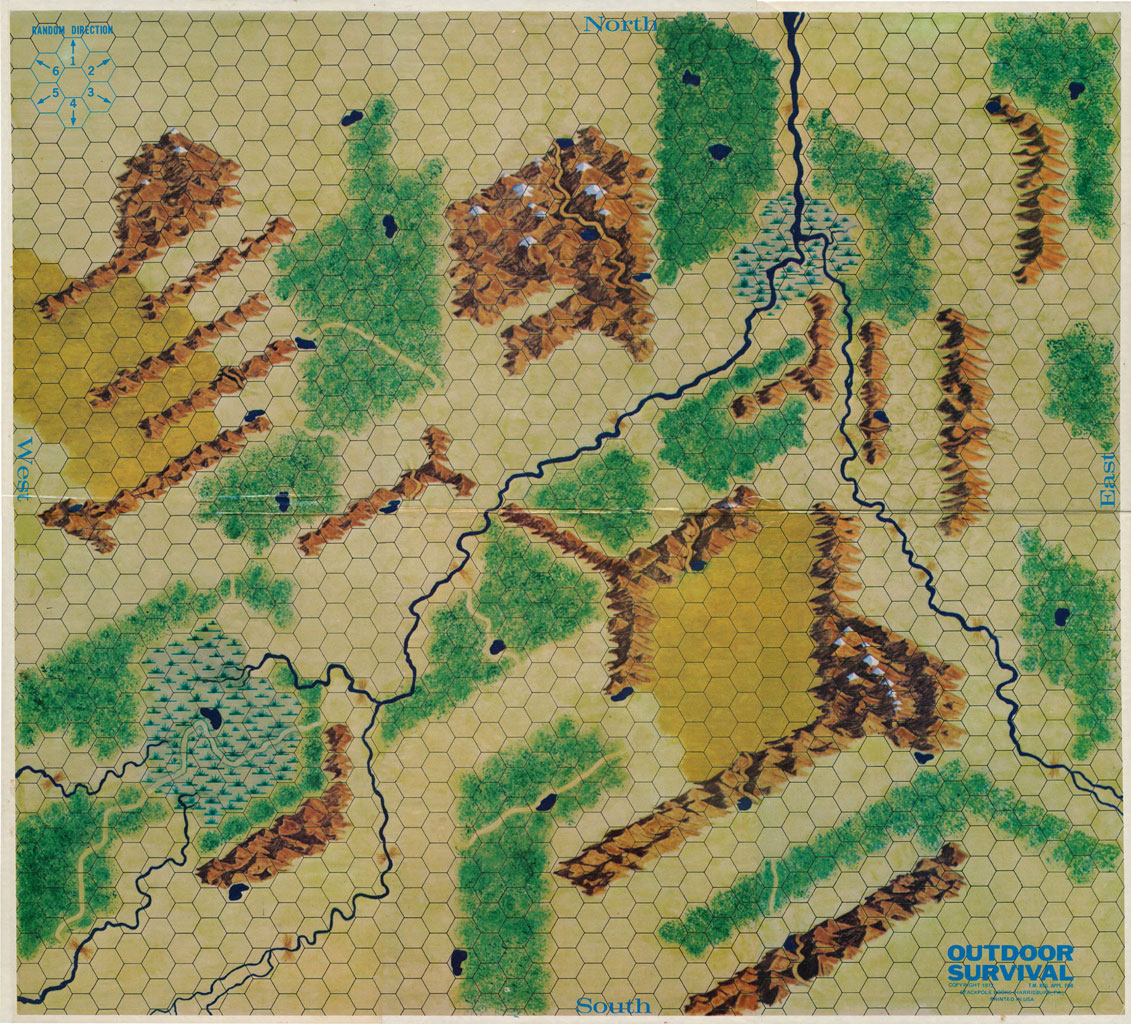
Something I want to do differently though is integrate the dungeon into the world a bit more, something I left was seriously lacking with my previous endeavor. So, I decided to follow Scott of Huge Ruined Pile and the guy from Sword +1's  example and take a look at the Outdoor Survival map. For some reason, though, the mountain-infested desert in the northwest corner has always bugged the crap out of the me. I'm not even sure why. But I decided to give it a chance, drafted up the map in Hexographer, replaces the sink holes with castles,  pondered the result, and insultingly decided I want to go with something else.


Then I remembered, a blog a quite enjoyed during its all too short life span, Swords of Minaria. The map of  Minaria from the Divine Right board game (which I have never played and know almost nothing about) is incredibly evocative, and yet still very flexible. I mean, come on, a city named "Huts of the Scum" or a "The Invisible School of Thaumaturgy," how incredibly awesome is that? The map provides just enough detail to get my creative wheels churning and nothing more. It's perfect.


Honestly, looking through the map there are many great locations to turn into a megadungeon. A few I'm considering are The Stone Face near the Trollwood; the Shards of Lor between the Creeping Forest and the Tower of Zards; Stubstaff Keep near the Thorn Flats; Spires of the Sun near the Forbidden Oasis; and Alters of the Grey Staff in the Blasted Heath. Out of those, Stubbstaff Keep is the most centralized location. But I'd really like a mountainous location. On a second pass though, the Nithmere Mountains right between Immer and Zorn looks like another good spot. And The Sunken City Parros caught my eye. As you can see, there are almost too many evocative names on this map to choose just one.

Another idea I've been consider , instead of giving the megedungon a specific location, is to have an intrecut system of gate/portals into different sections of the megadungeon scattered throughout the land.

In the end, I think it will just depend on what type of megadungeon I come up with. Well I've got two hours every day this week before class to work. I'll see what I come up with and go from there. I just need to remember to bring my mapping gear to the library and I'll be ready to excavate.

Tuesday, July 5, 2011

Vancian D&D

In my opinion, Jack Vance's Dying Earth is under-appreciated when it comes to inspiration for roleplaying games. While many know that Vance was the inspiration Gary's magic system in D&D, I find it to be one of the least useful aspects of the Dying Earth to replicate.

What's truly brilliant about Vance is his wilderness adventures. How one moment your trekking through the wilderness and the next you've found yourself in a nice little village that turn out to be unbelievably creepy or insane about halfway through the story. It's just awesome.

Not only that, but he has the most scheming cast of character I've ever seen in a fantasy novel. There's no Frodo going out to same the world from utter destruction. No. Instead, you've got Cudgel, the greedy womanizing bastard who somehow always seems to stay a step ahead of adversity. Just about every character knows what they want and will do just about any to reap the potential benefits. Actually, most of Vance's character act quite like the  PCs in most games I've ran or played in.

Now, that doesn't mean I don't sometimes think Vance is a bit of a sadist on paper. He is a little bit, but at least he's a great one. No really, I bet you could pick up a the Dying Earth, flip to a random page and come up with a great villain for that night's session; I've done it.

So, that turned into more of a rant than I originally planned. Guess I have to include a new rule, monster, magic item, NPC, or something now:

Worms Upon the Lier
MU 4
Duration: Permanent

This spell must be cast one a creature making an oath. Any time thereafter that the oath is broken, the oath-breaker will erupt in the horde of writhing blue worms. These worms will fuse into two monstrous strands, eating away at oath-breaker's body. If the oath was not to divulge information of a curtain kind, the wormy tendrils (4HD each) will seek out the confident or interrogator and mash him into a blood-bony soup.

Sunday, July 3, 2011

Thoughts on Small But Vicious Dog

This morning I've been looking through, Chris Hogan's Small But Vicious Dog, a D&D/Warhammer Fantasy Role-Play hybrid, that caught my eye when glancing over Jeff's Gameblog. The document itself is definitely worth a read through, but what has really got me thinking is a short section towards the end of the text:
"Making the PCs suffer best evokes the spirit of the source material that inspired SBVD. Put them through the wringer as much as possible before their inevitable, ignominious demise. Killing characters off is no fun; doing everything just short of that is much more entertaining."
As you may know, I'm quite a killer DM. Not so much as the B/X Blackrazor guy, but even he is a little overkill for my tastes. Regardless, this section has really got be rethinking my whole gaming philosophy.

I like a sense that death could jump out and smack you in the face at any moment in my games. I feel that the expectation that the party will come out unsuccessful really adds to the sense of fulfillment when everything does pan out, and skilled play is put on a massive pedestal compared to that 18/00 strength you happened to roll during character creation.

On the other hand, I think Mr. Hogan has a point. There's a huge specrtum between being just fine and dandy and dead on your back in the middle of the dungeon. I just have to think more about what exactly that middle ground actually is.

Saturday, July 2, 2011

Sir Rolland de Gwyn and the Lance of the Unending Joust

As you may have figured out, I have an obsession with major NPCs doing very strange things to attain immortality.

One of those NPCs is Sir Rolland de Gwyn (a Lawful champion) or, as he is more commonly known, Knight of the Unending Joust. This knight, dressed in shining mail (plate mail +2), travels the land in a search of knights and unweary adventurers to challenge. For he carries with him the Lance of the Unending Joust, the secret to his youth. Even the oldest tavern-goes cannot remember the day before the Knight of the Unending Joust road the plains of Avalon.

His third squire, Lurit II, travels with him always. He is the grandson of Lurit I, the Knight's first squire--from a time when he was but a mortal man. Rumor has it that Sir Rolland now seeks another worthy squire to take Lurit's place when the squire is knighted in the court of Efflur.

Lance of the Unending Joust
This 13” wooden lance is tipped with closed fist made of a bright, cast-steel. The Lance of the Unending Joust acts as a lance +1, +3 vs. fighting-men. For every joust the user win, he does not age the following year. What the common, contender does not know, however, is that for every time the user is unseated himself, he immediately ages one year. Thus a knight of unmatched skill may achieve immortality with the Lance of the Unending Joust, but an unworthy squire will likely meet an early end.

Friday, July 1, 2011

New Magic Item: The Moon Cloak

Here's a new magic item I thought up today when getting groceries for dinner. What vindaloo curry has to do with either moons or cloak, I have no idea, but it was apparently nonetheless inspiring.


Moon Cloak
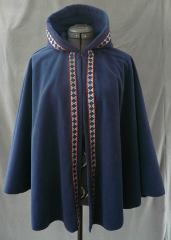
This magical navy cloak is a boon to magicians and thieves alike. It is fastened with a silver clasp enchanted to appear as the silhouette of the moon in the night’s sky—changing shape with each of its phases. The magic imbued by the cloak likewise changes with the phases of the moon.

Full Moon: During the full moon, the wearer is able to see in total darkness as the brightest moonlight.

Waxing Moon: If the wearer dies as as the moon waxes there is a 10% chance per level of the wearer that he will be reincarnated, as per the spell, within 1d6 hours.

New Moon: During the New Moon the cloak and anything within it, such as a man-like creature or similar sized object is wreathed in an invisibility enchantment.

Waning Moon: As the moon wanes the wearer may assume the form of a beautiful young woman (if wearer is female) or an elderly, bearded man (if male) after speaking the command word, metamorphone lunarium, and retains the form until the cloak is removed. It is always the visage of one of two identical figures, no matter who wears the moon cloak. In any city or large town, there is a 5% chance that wearer will be persecuted for the crimes a previous owner of the cloak once committed.

OD&D Monster Level Tables

Looking over pages 10 and 11 of Vol. 3: The Underworld and Wilderness Adventures, I'm beginning to notice that dungeon level in OD&D does not necessarily equal the appropriate character level. On level 6, for example, a group of character may regularly encounter 1-8 giants, a 9-12 head hydra, 1-6 basilisks, 1-4 gorgons, 1-4 chimeras, 1-6 vampires, lords, balrogs, wizards, evil high priests, and 1-4 purple worms. I'm not sure a group of 6th level character can really take those on with much chance of survival.

However, myrmidons (6th level fights) can be found on level 4 and enchanter (6th level magic-users) on level 3. Bishops are not included on the monster level tables. This I would guess that levels 3-ish to 4-ish are more suitable for a group of 6th level characters. Similarly, Men and Magic provides rules for characters up to 12 level (wizards), but provides only 6 levels of monster tables.

Based on pages 10 and 11, here is my best guess at to suitable dungeon levels for players characters in OD&D:

Dungeon Level 1 - 1st & 2nd level characters

Dungeon Level 2 - 2nd & 3rd level characters

Dungeon Level 3 - 4th to 6th level characters

Dungeon Level 4 - 6th & 7th level characters

Dungeon Level 5 - 7th to 9th level characters

Dungeon Level 6 - 8th to 12th level characters

What do you guys think?

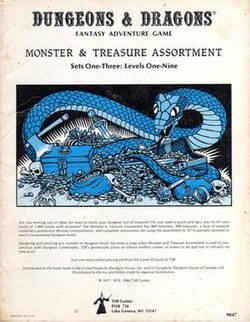
Monsters & Treasure Assortment: Levels One-Nine

I have recently acquired a cope of the  Monsters & Treasure Assortment: Levels One-Nine supplement. Essentially, the Monsters & Treasure Assortment is a set of random d% tables to help the DM determine the monsters and treasure on each level of their dungeon. There are also a number of more minor tables scattered throughout the first few pages, such as one for traps guarding treasure ("Treasure is guarded by...") or a table for where the treasure is hidden ("Treasure is hidden by/in...").

What intrigues me most is that the monsters are treasure found in this book are not specific to any one version of the game. Monsters solely found in AD&D and presented right next to monsters only found in Moldvay basic scatted with treasure found only in OD&D. This is a supplement that obviously defies a single, unified game.

While the monsters and treasure presented in the book are obviously scaled by the level of the PCs, there is definitely an attempt to keep players on their toes, such as including a Warlock (8th level magic-users) as a possible opponent on the second level of the dungeon. If that doesn't for the players to start using their heads (assuming the warlock does just cast fireball), I don't know what will. At the same time, there are a number of opponents that would normally be considered much too easy on lower dungeon levels.

Treasure, on the other hand, is much more uniform. There are no curse weapons on the first level and the first time a +2 weapon shows up is a dagger +2 on level three (never mind, there's a spear +3 on level 2) . Similarly, there is a much larger percentage of monetary treasure on the first level compared to more difficult areas. In general, like monsters, treasure seems to scale with dungeon level, but there are definitely some major wrenches in those gears, much to my appreciation.

Overall, I'm finding the Monsters & Treasure Assortment to be a great resource, something that games like Labyrinth Lord or Swords and Wizardry should consider cloning.