I've often found that the "alternative" combat system, the combat system adapted for AD&D and B/X, to be inadequate at times. There are situations where a mass of goblins or like creatures (in my case, redcaps) would be better represented as a single figure. It's just too hard to keep track of 10+ creatures/characters and forces play slows down significantly. Similarly, it would be nice if there was a faster way to determine the victor in higher-level combats. It just takes too long to go through 50 hit points or more before one side falls or retreats. In my AD&D game, however, my players, are still at too low a level for this to really be necessary at the moment, so I haven't had to deal with it much.
Chaimmail, the tactical miniatures wargame from which D&D gains its antecedence, has three combat systems that encompass differing scale of time and the number of figures represented. The three systems as the Mass Combat system, the Man to Man system (which is the closest of the three to the alternative combat system) and the Fantasy Combat table. Each of these three systems could be very useful in any given gaming session.
The Mass Combat system assigns each figure at troop type which determines its fighting capabilities. While the Mass Combat system is intended used for a 1:20 score, I've used it successfully to represent several higher level D&D characters fighting off a horde of skeletons without much difficulty (although it did take a little forethought as to how to do it properly). This method sped up play significantly so that we could get done with the encounter and back to the exploration.
The Man to Man rules are great for one-on-one combats and skirmish situations against human or near human opponents. This combat system creates a very gritty and tactical game that lends itself well to encounters with important NPCs. The Man to Man rules wouldn't be my go-to system for most combats, but for duels, gladiatorial matches, important skirmishes amidst a larger battle, and important battles you want to carry tension and weight I find them exceptional.
The Fantasy Combat table allows for a way to determine the victor of high level battles by a single die roll. I find that the Fantasy Combat table works best when used in conjunction with the Man to Man or Mass Combat systems. At its best, the Fantasy Combat table allows a hero to make an unlucky, last-ditch attack against a more powerful opponent with a small chance of killing that opponent outright.
That is not to say that there are no problems associated with the three Chainmail combat systems. The major issues I've found are that it is often tricky to assign troop types in the Mass Combat system; that some weapons (fails and two-handed swords) are vastly more powerful than others in the Man to Man system; and the Fantasy Combat table can often lead to anti-climactic results if overused.

"A doomed man needs no such elegant footwear." - Jack Vance, Eyes of the Overworld
Showing posts with label Chainmail. Show all posts
Showing posts with label Chainmail. Show all posts
Tuesday, March 8, 2011


Thursday, July 15, 2010
More Thoughts on Chainmail
I'm moving away from thinking about how to use Chaimail as the OD&D combat engine. Chaimail and OD&D just have too many disparities between them to really synthesize them in a way that is true to the word of each ruleset, although the opinion of the reader may vary from my own. Instead, I've been taking aspects of Chainmail and D&D and rebuilding them from the ground up.
How did this all start? When I was working Swashbuckler! yesterday, I noticed that many of my sword fighting mechanics could be easily ported into, and were like inspired by, Chainmail. I'm not quite ready to talk too much about swashbuckler yet, so I'll discuss my Chainmail/D&D fusion experiment instead. Keep in mind, however, that I am not attempting to unitize whole (or even partial) pieces of either the Chainmail or D&D rulesets.
Basic Combat
Each character and creature fights as a number of men. Player characters, for example, fight as a number of men equal to their level. Rather than having separate attackers and defenders, creatures engaged in melee attack simultaneously. In a two person combat, each combatant rolls a number of d6s equal to his or her fighting capability (equal the number of men he or she fights as). Successful rolls are determined (depending on troop type) and the number of successes are compared. the combatant with the greater number of successful rolls is the victory and slays his or her opponent.
Depending on a combatant's troop type, he may gain certain advantages over his opponents. Take a a light footman fighting an armored footman for instance. For each single success, the light footman needs three if his attack dice to roll 6s. On the other hand, the armored footman's need to roll a 4 or higher for a roll to be considered a single success. Thus, a single light footman with a fighting capability of 1 man cannot defeat an armor footman of the fighting capability. Even three light footmen have a difficult time taking on a single armored footman.
Now, I'm considering some sort of critical hit table rather than instant death. But for the time being, this is mostly a brainstorming exercise, although it might very well turn into something more.
Fantasy Combat
The Fantasy Combat Table allows characters to take on mythical creatures with a slightly higher chance of success than when using the basic combat rules. Each combatant rolls 2d6 and compares it to the fantasy combat table. If one combatant succeeds his or her roll while the other does not, the successful combatant slays his or her foe. Otherwise the combat continues into the next round. Neither combatant's troop type is factored into the combat table. Only heroes (4th level and higher characters) may roll on the Fantasy Combat Table.
Character Classes
Fighters attack and defend as Armored. After reaching hero level, fighters always have the option of rolling on the Fantasy Combat Table.
Thieves attack and defend as Light. When attack unnoticed from behind, thieves throw 1 additional die from 1st to 3rd level. They throw 2 additional dice from 4th through 7th level, and 3 additional dice from 8th to 12th level. Only when backstabbing, does a thief have the option of rolling on the Fantasy Combat Table and only after reach hero level. (Note that thieves also possess increased chances to hide, move silently, pick locks etc.)
Wizards attack and defend as Light. Starting at 1st level, wizards are able to cast spells. The maximum [complexity or level] of a spell a wizard is able to cast is equal to half his level, rounded up. Wizards may never roll on the fantasy combat table.
Clerics attack and defend as Heavy. They are able to turn units worth of undead creatures. Starting at 2nd level, clerics are able to cast spells. The maximum [complexity or level] of a spell a cleric is able to cast is equal to half his level, rounded down. Only against undead, demons, and other unholy creatures and having reached hero level may clerics opt to roll on the fantasy combat table.
How did this all start? When I was working Swashbuckler! yesterday, I noticed that many of my sword fighting mechanics could be easily ported into, and were like inspired by, Chainmail. I'm not quite ready to talk too much about swashbuckler yet, so I'll discuss my Chainmail/D&D fusion experiment instead. Keep in mind, however, that I am not attempting to unitize whole (or even partial) pieces of either the Chainmail or D&D rulesets.
Basic Combat
Each character and creature fights as a number of men. Player characters, for example, fight as a number of men equal to their level. Rather than having separate attackers and defenders, creatures engaged in melee attack simultaneously. In a two person combat, each combatant rolls a number of d6s equal to his or her fighting capability (equal the number of men he or she fights as). Successful rolls are determined (depending on troop type) and the number of successes are compared. the combatant with the greater number of successful rolls is the victory and slays his or her opponent.
Depending on a combatant's troop type, he may gain certain advantages over his opponents. Take a a light footman fighting an armored footman for instance. For each single success, the light footman needs three if his attack dice to roll 6s. On the other hand, the armored footman's need to roll a 4 or higher for a roll to be considered a single success. Thus, a single light footman with a fighting capability of 1 man cannot defeat an armor footman of the fighting capability. Even three light footmen have a difficult time taking on a single armored footman.
Now, I'm considering some sort of critical hit table rather than instant death. But for the time being, this is mostly a brainstorming exercise, although it might very well turn into something more.
Fantasy Combat
The Fantasy Combat Table allows characters to take on mythical creatures with a slightly higher chance of success than when using the basic combat rules. Each combatant rolls 2d6 and compares it to the fantasy combat table. If one combatant succeeds his or her roll while the other does not, the successful combatant slays his or her foe. Otherwise the combat continues into the next round. Neither combatant's troop type is factored into the combat table. Only heroes (4th level and higher characters) may roll on the Fantasy Combat Table.
Character Classes
Fighters attack and defend as Armored. After reaching hero level, fighters always have the option of rolling on the Fantasy Combat Table.
Thieves attack and defend as Light. When attack unnoticed from behind, thieves throw 1 additional die from 1st to 3rd level. They throw 2 additional dice from 4th through 7th level, and 3 additional dice from 8th to 12th level. Only when backstabbing, does a thief have the option of rolling on the Fantasy Combat Table and only after reach hero level. (Note that thieves also possess increased chances to hide, move silently, pick locks etc.)
Wizards attack and defend as Light. Starting at 1st level, wizards are able to cast spells. The maximum [complexity or level] of a spell a wizard is able to cast is equal to half his level, rounded up. Wizards may never roll on the fantasy combat table.
Clerics attack and defend as Heavy. They are able to turn units worth of undead creatures. Starting at 2nd level, clerics are able to cast spells. The maximum [complexity or level] of a spell a cleric is able to cast is equal to half his level, rounded down. Only against undead, demons, and other unholy creatures and having reached hero level may clerics opt to roll on the fantasy combat table.
Wednesday, May 26, 2010
Armor of the Viking World
There were three main types, pieces rather, of armor during the viking age: the shield, the helm, and mail (chainmail). Of those three pieces, only shields were cheep enough to be of any widespread use. Helms and mail where extremely expensive and offered little protection compared to shields. If you could afford a helm or shirt of mail, you would have one, but only chieftains and war leaders were likely to such funds.
Shields: Shields where circular and nearly a meter in diameter. They were made of wooden boards and had a central hole for an iron hand-grip, which was riveted to the back of the boards. The fronts of shields where reinforced with leather and pained with family and village crests. In addition, to their defensive uses, shields could be employed aggressively to knock an opponent or his weapon off balance, making to easier to strike a telling blow. Axe blows had devastating effects on shields.

Mail: Mail was a protective iron fabric made up of thousands of interlocking iron rings. During the Viking age, mail usually was worn in the form of a mail shirt that went down, past the elbows and hung past the thigh. Padded garments, such as many layers of thin linen or randier hide, where always worn underneath a mail shirt to absorb the shock of a blow, since the mail itself only really prevented against slashing. Once again, I'd like to repeat that mail was exceptionally and limitingly expensive. Anyone who could have afforded one would certainly have wanted one, but probably few people could afford one.

Helms: Helms where expensive to buy, difficult to craft, and provided protection only to the head. For that reason, helms where even more rare than shields or mail. However, very few broken or damaged helms have ever been discovered, meaning that the helmets worn during the viking age did a great job protecting the bearer's head.

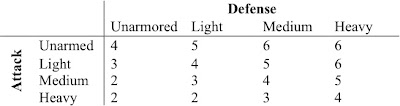
As I mentioned before, I will be using a pseudo Chainmail based combat system for this campaign. All characters are assigned an attack class (unarmed, light, medium, or heavy) and an armor class (unarmed, light, medium, or heavy) based on what arms and armor the character uses. For each piece of defensive equipment (helm, mail, or shield) a character employs, increase the character's armor class by one step. Therefore, a character wearing a helm and using a shield would have medium armor.
The matrix below lists the number (rolled on a d6) necessary to hit an opponent with a certain armor class with a certain attack class. A character wielding an axe in two hands would need to roll a 4 or higher to hit an opponent wearing mail and using a shield.
Shields: Shields where circular and nearly a meter in diameter. They were made of wooden boards and had a central hole for an iron hand-grip, which was riveted to the back of the boards. The fronts of shields where reinforced with leather and pained with family and village crests. In addition, to their defensive uses, shields could be employed aggressively to knock an opponent or his weapon off balance, making to easier to strike a telling blow. Axe blows had devastating effects on shields.

Mail: Mail was a protective iron fabric made up of thousands of interlocking iron rings. During the Viking age, mail usually was worn in the form of a mail shirt that went down, past the elbows and hung past the thigh. Padded garments, such as many layers of thin linen or randier hide, where always worn underneath a mail shirt to absorb the shock of a blow, since the mail itself only really prevented against slashing. Once again, I'd like to repeat that mail was exceptionally and limitingly expensive. Anyone who could have afforded one would certainly have wanted one, but probably few people could afford one.

Helms: Helms where expensive to buy, difficult to craft, and provided protection only to the head. For that reason, helms where even more rare than shields or mail. However, very few broken or damaged helms have ever been discovered, meaning that the helmets worn during the viking age did a great job protecting the bearer's head.

As I mentioned before, I will be using a pseudo Chainmail based combat system for this campaign. All characters are assigned an attack class (unarmed, light, medium, or heavy) and an armor class (unarmed, light, medium, or heavy) based on what arms and armor the character uses. For each piece of defensive equipment (helm, mail, or shield) a character employs, increase the character's armor class by one step. Therefore, a character wearing a helm and using a shield would have medium armor.
The matrix below lists the number (rolled on a d6) necessary to hit an opponent with a certain armor class with a certain attack class. A character wielding an axe in two hands would need to roll a 4 or higher to hit an opponent wearing mail and using a shield.

Weaponry of the Viking World (Part 2)

In just about any edition of D&D, there is a plethora of weapons to choose from. In the viking age, not so much. In this campaign, I'm planning on their being five standard weapons: spears, axes, swords, saxes (singe edged daggers), and bows. With that few choices, there is the opportunity to make each weapon unique.
For this game I will be using a pseudo Chainmail based combat system. All characters are given attack class (unarmed, light, medium, or heavy) and a armor class (unarmed, light, medium, or heavy) based on what arms and armor the character uses. For each piece of defensive equipment (helm, mail, or shield) a character employs, increase the character's armor class by one step. Therefore, a character wearing a helm and using a shield would have medium armor.
All weapons deal 1d6 points of damage per hit. The attack class of a weapon, depends on its size, speed, and ability to penetrate armor.
Axe: Medium. +1 damage when wielded in two hands.
Bows: Light. 240ft range. May make one additional attack per round.
Sax: Light. Can be used even in extremely constricted location. Strikes last in the initial round of combat, but strikes first from then on.
Spear: Medium. Requires two hands. Strikes first in the initial round of combat, but strikes last from then on. 30ft range when thrown.
Sword: Heavy. Elegant and exceptionally expensive.
The matrix below lists the number (rolled on a d6) necessary to hit an opponent with a certain armor class with a certain attack class. A character wielding an axe in two hands would need to roll a 4 or higher to hit an opponent wearing mail and using a shield.
Monday, May 3, 2010
Thoughts on Using Chainmail in OD&D
Lately, I've been think a lot about how best to use chainmail when running OD&D. I'm thinking that each character would be assigned a troop type (light, heavy, or armored), al la the chainmail mass combat system, depending on character's arms, armor, and the situation at hand.
For example, a character wielding a longsword might be considered a "light footman" when attacking an opponent in plate mail (who would considered an "armored footman"), but a character with a mace would be considered an "Armored Footman" when attacking the same opponent. Both characters were wielding a one handed weapons and, therefore, normally attack as "heavy footman." Longswords, being almost completely useless against plate mail, become "light" while a mace, very effective against plate mail, becomes heavy. However, when attacking a opponent is leather, on the other hand, a longsword would become "armored" and a mace would become "light."
Depending on the exact situation, even a dagger could become "armored" and a two-handed sword "light." What I like about this is that all weapons have their place to shine, and , depending on the situations, different weapons will be more effective than others. There are too many circumstances to make a table or anything, so everything will have to be done on the fly, but with only three categories of troops it shouldn't really be too difficult to do.
More powerful characters and monsters would then fight as a larger number of men and would have special abilities, spells, etc. A giant, for example, would light as ten men, but because of its size would likely fight and defend as "a light footman." And, since armor would not really protect a character against the blows of a giant, all character would defend as "light footman" as well. Characters armed with spears or other long, shafted weapon would fight as "heavy" while just about anyone else would fight as "light."
Keeping in mind that I haven't quite thought everything through, What do you guys think? Does this idea have potential?
For example, a character wielding a longsword might be considered a "light footman" when attacking an opponent in plate mail (who would considered an "armored footman"), but a character with a mace would be considered an "Armored Footman" when attacking the same opponent. Both characters were wielding a one handed weapons and, therefore, normally attack as "heavy footman." Longswords, being almost completely useless against plate mail, become "light" while a mace, very effective against plate mail, becomes heavy. However, when attacking a opponent is leather, on the other hand, a longsword would become "armored" and a mace would become "light."
Depending on the exact situation, even a dagger could become "armored" and a two-handed sword "light." What I like about this is that all weapons have their place to shine, and , depending on the situations, different weapons will be more effective than others. There are too many circumstances to make a table or anything, so everything will have to be done on the fly, but with only three categories of troops it shouldn't really be too difficult to do.
More powerful characters and monsters would then fight as a larger number of men and would have special abilities, spells, etc. A giant, for example, would light as ten men, but because of its size would likely fight and defend as "a light footman." And, since armor would not really protect a character against the blows of a giant, all character would defend as "light footman" as well. Characters armed with spears or other long, shafted weapon would fight as "heavy" while just about anyone else would fight as "light."
Keeping in mind that I haven't quite thought everything through, What do you guys think? Does this idea have potential?
Subscribe to:
Posts (Atom)