Wednesday, March 23, 2011

B/X/C Vikings: Classes

First See:
B/X/C Viking: Introduction

CHARACTER CLASSES
Characters can be Dwarves, Fighters, Half-Giants, Mages, Thieves, Skalds, and Wizards. Characters may not advance past 14th level.

Dwarves – No infravision. After reaching 9th level, dwarves may forge magical arms and armor as a magic-user.

Fighters – There are several special combat maneuvers that can only be used by fighters, such as going berserk and shield bashing.

Mages and Wizards – There are two types of magic-users: wizened old Wizards, knowledgeable but weakened with age and powerful, arrogant Mages. The first is represented by the magic-user class. The second by the “elf” class, only without infravision, additional languages, immunity to the paralyzing touch of ghouls, and have the normal chance to find secret doors.

Skalds – Skalds are warrior-poets and collectors of Nordic lore. Sitting around the firesides, Skalds inspire their comrades with tales of honor in battle, the glories of victory, and the hardships of loss. (This class is based on the Bard is JB’s B/X Companion.)

  • Prime Requisite: Charisma
  • HD: d6
  • Experience Progression: As Clerics
  • To Hit, & Save Progression: as Elves
  • Weapons and Armor: Any
  • A Skald’s poetry can inspire those around him or even create magical effects. Skalds learn to produce the following spell-like powers at different levels of experience.
  • A skald learns one additional language for every level after first (in addition to Nodic and any languages from high intelligence).
    A bard has a chance base on level to know useful legends or lore regarding geographical regions, heroic personages, and legendary magic items. This chance is the same as a thief’s chance to pick pockets.

Skald Spell-Like Powers By Level
1st level: Bless (requires 1 turn to take affect)
2nd level: Remove Fear (requires 1 round to take affect)
3rd level: Instill Fear* (requires 1 minute to take affect)
4th level: Charm Person (requires 1 turn to take affect)
5th level: Dispel Magic (requires 1 turn to take affect)
6th level: Remove Curse (requires 1 turn to take affect)
7th level: Phantasmal Force (requires 1 turn to take affect)
8th level: Cause Fear (requires 1 minuet to take effect)
9th level: Ant-Magic Shell (requires 1 turn to take affect)
* Forces one humanoid creature per level of the Skald within earshot to make a moral roll or flee/surrender.

Thieves – Just as likely to be spies, scouts, woodsmen, and men of cunning than tomb robber or adventurous burglars. Thieves can Track as they would find/remove traps.

Half-Giants – Half-Giants stand head and shoulders above most mortals and are viewed with superstitious awe by humans. While monstrously strong, half-giants are not especially agile or clever and tend to be rude or unkempt.

  • Requirements: 13 or greater strength and constitution; 12 or less dexterity; 9 or less intelligence, and charisma
  • Prime Requisite: Strength
  • HD: d10
  • XP, To Hit, & Save Progression: as Halfling (max 8th level)
  • Weapons and Armor: Any, although armor must be refit to a half-giant and costs twice the normal amount.
  • Half-Giants must make a saving throw vs. spell after each around of combat to avoid going berserk.

B/X/C Vikings: Introduction

A couple of days ago, I did a brief post on Viking and Valkyries supplement to Mazes and Minotaurs. Long have I been enamored with the idea of a Viking themed campaign, but never has this dream been realized. Well, once again, I can't keep Viking D&D out of my head, so I decided to have a little fun and began to create a series Nordic-themed posts. in lieu of Zak's "give us the setting in the form of rules", I've gone ahead and written them to suite B/X/C Dungeons and Dragons (the "C" standing for JB's B/X Companion).

I'd appreciate some feedback on this set of posts, because once I'm done, I'm going to roll them all together and format it into a PDF for you all to enjoy and hopefully use. The more feedback, the the final product will be.

On a final note, I'm not really trying to stick to Norse mythology. I'm taking it into consideration, but often only using it for inspiration. For this mini-project I'm going for a more gonzo approach rather than a mythological or historical one.

Monday, March 21, 2011

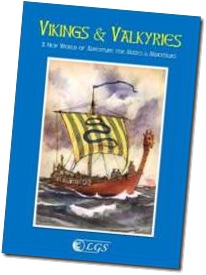
Vikings & Valkyries

Mazes and Minotaurs is one of those games that I've always wanted to play, but have never gotten around to. Consequently, I always like to check out if there is another MINOTAUR Quarterly once every six months, or year, or so.

When I popped back last time, just a few days ago, I found something that really caught my eye: Vikings & Valkyries. According to the forward, "Vikings & Valkyries is the first instalment of the new Worlds of Adventure line of supplements for the Mazes & Minotaurs role-playing game – a line which, as its name implies, takes the Mazes & Minotaurs system away from its classic setting inspired by mythic Greece and sword-and-sandal movies to other legendary universes, each with its own deities, monsters and special rules."

Now, I doubt that there is ever going to another Worlds of Adventure supplement, but I'm liking what I see from Vikings & Valkyries. I've always wanted to run a Viking inspired D&D campaign, and this just adds another stone to the pile. Who knows with spring break here, I might just have to write a string of viking related posts like I did with Chainmail a week or so ago.

Among my favorite additions are the Maiming Opponents (p. 12, Viking Games (p. 15-16), and Wergild (p. 17) sections. Who wouldn't want to add pierced eyes and braid cutting into their game after all?

Due to a few major qualms with Mazes and Minotaurs (mostly involving ability scores), I doubt I'll ever get around to playing either game straight up, but that doesn't mean these excellent sources aren't worth mining for gems; there sure are plenty to be found. So if you haven't done so already, I highly recommend checking out Vikings & Valkyries.

Review: Old School Hack


It's spring break and my Old Forest campaign is on a bit of a hold with all but one player out of town for the next could week. In the mean time, I've gotten to play two one-shots of a game call Old School Hack. It's still in development, but I decided to give it a shot.

They were two excellent sessions. I mean really excellent. Very Gonzo, yes, but a whole lot of fun. I had to break out of my shell a little and went for a very Bonsoomian adventure to get the feel right: it was a blast (literally, at times).

What surprised me most was how much I enjoyed combat. Usually combat tends to be one of my least favorite parts of the game, but there's something about the chaotic tendencies of this game that make characters was to dive from flying shuttles and crush their enemies with a good old fashioned round-house kick. It was hilarious; the whole thing was just wacky. Great for one-shots, but I have my doubts about it for long term play.

The players had a lot of fun choosing talents for their characters. The Dwarf's Impressive Partier talent was especially popular. It was the first time when I saw characters choosing non-combat over combat oriented ability. I think that was total in the spirit of the game and I definitely make some...unconventional...ruling to that the players could use those flavorful talents.

The one serious problem I saw with the game was the leveling system. To gain a level of experience, every member of the party must each expend 12 awesome points. While it worked out well for our one-shots. I can see problems in a longer campaign-type model. I really just not sure what to do if a player misses a session. I'm just completely stumped. I'll have to on that.

Overall, we all had a blast, despite all of the new-school additives, like per combat abilities. I just decided to go for it and it turned out great. Excellent game, but I can't see it being all that great for long term play.

Friday, March 11, 2011

OD&D clerics and Zoroastrianism

History classes are great inspiration for roleplaying games. Today in the Ancient Near Easter History class, we talked about Zoroastrianism, the major religion in Persia during and after the reign of Darius the Great.

In OD&D, clerics are split between the forces of Law and Chaos. While for some time a cleric can remain undecided between the two, "Clerics of 7th level and greater are either "Law" or "Chaos", and there is a sharp distinction between them" (M&M p. 7).

While the clerics of OD&D were most likely meant to represent medieval orders of Christian knights (Gary himself was a practicing Christian and often inspired by his faith), I find Zoroastrianism a much better fit.

Zoroastrianism was [is] a dualistic religion, meaning that it was neither mono or polytheistic. There were two gods: Ahriman and Ahura-Mazda. Ahriman was the god of darkness while Ahura-Mazda the god of light. According to Zoroastrianism, these two beings are engaged in an epic cosmic conflict over the universe that is thought to last 12,000 (about 6,000 years from the present day).

Some of the minor, but defining features of Zoroastrianism beliefs are demons that were once gods, the resurrection of Ahura-Mazda, angels (of both Ahriman and Ahura-Mazda), and fire alters and the centers of religious worship, all of which fit quite well into the OD&D framework.

If you had to sum up Zoroastrian ethics with a single line from the Zend-Auestra (the sacred Zoroastrian text), that line would be "good thoughts; good works; good deeps."

What really strikes me is the cosmic battle between light and darkness, or, in OD&D terms, Law and Chaos. I also find that reverse spells fit very will into this paradigm.

Tuesday, March 8, 2011

Chainmail's 3 Combat Systems and Their Uses in OD&D

I've often found that the "alternative" combat system, the combat system adapted for AD&D and B/X, to be inadequate at times. There are situations where a mass of goblins or like creatures (in my case, redcaps) would be better represented as a single figure. It's just too hard to keep track of 10+ creatures/characters and forces play slows down significantly. Similarly, it would be nice if there was a faster way to determine the victor in higher-level combats. It just takes too long to go through 50 hit points or more before one side falls or retreats. In my AD&D game, however, my players, are still at too low a level for this to really be necessary at the moment, so I haven't had to deal with it much.

Chaimmail, the tactical miniatures wargame from which D&D gains its antecedence, has three combat systems that encompass differing scale of time and the number of figures represented. The three systems as the Mass Combat system, the Man to Man system (which is the closest of the three to the alternative combat system) and the Fantasy Combat table. Each of these three systems could be very useful in any given gaming session.

The Mass Combat system assigns each figure at troop type which determines its fighting capabilities. While the Mass Combat system is intended used for a 1:20 score, I've used it successfully to represent several higher level D&D characters fighting off a horde of skeletons without much difficulty (although it did take a little forethought as to how to do it properly). This method sped up play significantly so that we could get done with the encounter and back to the exploration.

The Man to Man rules are great for one-on-one combats and skirmish situations against human or near human opponents. This combat system creates a very gritty and tactical game that lends itself well to encounters with important NPCs. The Man to Man rules wouldn't be my go-to system for most combats, but for duels, gladiatorial matches, important skirmishes amidst a larger battle, and important battles you want to carry tension and weight I find them exceptional.

The Fantasy Combat table allows for a way to determine the victor of high level battles by a single die roll. I find that the Fantasy Combat table works best when used in conjunction with the Man to Man or Mass Combat systems. At its best, the Fantasy Combat table allows a hero to make an unlucky, last-ditch attack against a more powerful opponent with a small chance of killing that opponent outright.

That is not to say that there are no problems associated with the three Chainmail combat systems. The major issues I've found are that it is often tricky to assign troop types in the Mass Combat system; that some weapons (fails and two-handed swords) are vastly more powerful than others in the Man to Man system; and the Fantasy Combat table can often lead to anti-climactic results if overused.

Tuesday, September 7, 2010

Accomplishments: A New Way of Awarding Experience Points

At A Paladin In Citadel, a read about Arduin's Experience Point System. The major complaint of such a complex method of awarding experience points is that it's just too much to keep track of.

Here's a new idea. Rather than awarding character's based on the gold they've collected, why not award it based on what the character has accomplished. A beginning character would have no accomplishments. Once a character completes a certain number of accomplishments, the character's level increase.

Here are some example accomplishments I thought up (most of which are class based):


GENERAL EXPERIENCE AWARDS

Taking part in a dangerous expedition that returns without casualties
Being the sole survivor of a disastrous expedition
Recovering a magical artifact
Dying and being brought back to life
Being gaining a title and lands
Joining a specific organization related to your class
Being promoted or rising in the hierarchy of that organization
Become head of that organization
Establishing an organization related to your class


CLERIC EXPERIENCE AWARDS

Recovering a relic of your chosen religion
Leading a pilgrimage to the holy land
Taking part in a crusade
Leading a holy crusade
Converting a follower
Converting a village
Converting a town
Converting a city
Converting a kingdom


FIGHTER EXPERIENCE AWARDS

Taking part in an organize battlefield regiment
Commanding an army of 10 or more men to victory
Commanding an army of 100 or more men to victory
Commanding an army of 1,000 or more men to victory
Commanding an army of 10,000 or more men to victory
Winning a duel or joust against a ordinary man
Winning a duel or joust against a man of arms
Winning a duel or joust against a master of arms
Winning a tournament of arms
Defeating a monster of legend


MAGE EXPERIENCE AWARDS

Creating a spell of 1st or 2nd level
Creating a spell of 3rd or 4th level
Creating a spell of 5th o 6th level
Brewing a potion
Creating a magic artifact


THIEF EXPERIENCE AWARDS

Thieving a single item worth at least 10 gold coins
Thieving a single item worth at least 100 gold coins
Thieving a single item worth at least 1,000 gold coins
Taking part in a heist
Leading a team of 3 or more thieves in a successful heist
Leading a team of 5 or more thieves in a successful heist
Leading a team of 10 or more thieves in a successful heist


Here's how I see this working. Character's go out into the work and below it to collect gold to fun their various operations that earn them fame and accomplishments.

Now, This isn't something I intend on using, but it was a fun exercise that I though someone might appreciate.