Friday, July 1, 2011

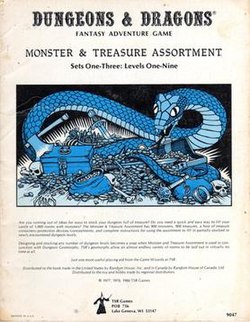
Monsters & Treasure Assortment: Levels One-Nine

I have recently acquired a cope of the  Monsters & Treasure Assortment: Levels One-Nine supplement. Essentially, the Monsters & Treasure Assortment is a set of random d% tables to help the DM determine the monsters and treasure on each level of their dungeon. There are also a number of more minor tables scattered throughout the first few pages, such as one for traps guarding treasure ("Treasure is guarded by...") or a table for where the treasure is hidden ("Treasure is hidden by/in...").

What intrigues me most is that the monsters are treasure found in this book are not specific to any one version of the game. Monsters solely found in AD&D and presented right next to monsters only found in Moldvay basic scatted with treasure found only in OD&D. This is a supplement that obviously defies a single, unified game.

While the monsters and treasure presented in the book are obviously scaled by the level of the PCs, there is definitely an attempt to keep players on their toes, such as including a Warlock (8th level magic-users) as a possible opponent on the second level of the dungeon. If that doesn't for the players to start using their heads (assuming the warlock does just cast fireball), I don't know what will. At the same time, there are a number of opponents that would normally be considered much too easy on lower dungeon levels.

Treasure, on the other hand, is much more uniform. There are no curse weapons on the first level and the first time a +2 weapon shows up is a dagger +2 on level three (never mind, there's a spear +3 on level 2) . Similarly, there is a much larger percentage of monetary treasure on the first level compared to more difficult areas. In general, like monsters, treasure seems to scale with dungeon level, but there are definitely some major wrenches in those gears, much to my appreciation.

Overall, I'm finding the Monsters & Treasure Assortment to be a great resource, something that games like Labyrinth Lord or Swords and Wizardry should consider cloning.

Tuesday, June 28, 2011

Wilderness Evasion and Pursuit

Evasion is another one of those rules I always forget about but actually love in theory. Essentially, evasion is the chance that the PCs are able to get away unnoticed from NPCs and monsters in the wilderness. Essentially, stealth.

First off, while castle inhabitants are likely to make PCs lives difficult if they wish to enter their walls, only hostile castle are likely to pursue the PCs into the wilderness, and only a 3 in 6 at doing that. Neutral occupants, on the other hand, have only a 1 in 6 chance of pursuit. Pretty good odds comparatively.

The chance of success for evading monsters is based on the number of PCs and retainers compared to the number of monsters encountered. Well, not quite the number of monster encountered, but the general percentage compared to the number appearing entry in the monster's stat blocks. As the number of characters increases, so does the difficulty of evasion. Likewise, larger numbers of monsters are easier to evade than smaller groups.

Woods add 25% to evasion chances and give a 10% chance of evasion even if surprised. Likewise, faster parties add 25% to their evasion chances, while slower parties subtract 25%. How that for a decent benefit of not wearing plate mail?

Unlike evasion, pursuit is done on a hex by hex basis with a relative chance based on the relative speed of the two groups:

Pursuit will take place whenever it is so indicated with regard to castle inhabitants or when a party is unable to evade monsters. A die is rolled, and the pursuit then goes in that random direction. If the monster is faster than the party involved there is a 50% chance it will catch the party. The party now moves another hex in a random direction, and a die is rolled to determine if pursuit will continue. If pursuit continues the chances for being caught by a faster monster are exactly the same, and the same procedure is repeated if the party is not caught. This procedure continues until pursuit is ended or melee occurs. Woods or swamp will reduce the chance of being caught by 25% (Underworld and Wilderness Adventures pg.20).

Overall, evasion and pursuit are rules for wilderness stealth just like surprise. Who says non-thieves in D&D can't hide or sneak of?

Monday, June 27, 2011

Wilderness Sightings, Surprise, and Getting Lost


Continuing my investigation of the highlights from Underworld & Wilderness Adventures, I'll next be dealing with surprise and monster sightings as well as getting lost in the wilderness.

Monster Sightings: "Players will see monsters at from 40-240 yards...unless the monster has surprised the characters involved" (pg 17). I guess this is where the range of missile weapons actually matters. if you want to make that crossbow a decent weapon, here you go: determine the distance of the monsters from the players and suddenly the advantages of a crossbow become clear.

Surprise: "This is the same as in the underworld, except that the distance is from 10-30 yards, and if there are three or more monsters involved they will have moved into a circle around the adventurers. Monsters at 10 yards distance will be able to attack" (pg 17). So not only do monsters close quickly with the players, but they also circle them, if possible. If you find that fighting-men are dying much more often than the magic-users in your campaign, this rule isn't being use enough (or that there are enough fighting-men to completely encircle the other members of the adventuring party).

Lost Parties: It's easiest (3 in 6 chance) to get lost in the a swamp and the desert where everything looks the same. 2 in 6 chance for mountains and woods. Those are some pretty high chances, in my opinion. Luckily (if I'm reading the text correctly), you won't veer too far in the wrong direction after only a single day of travel.

What confuses me is that there character have a 1 in 6 chance to get lost along a river. If anyone had an explanation or reading on this one, I'd love to hear it.

Wandering Monsters: In mountains and swamps, there is a 3 in 6 chance of encountering monsters and a 2 in 6 chance while adventuring in woods, near rivers, or in the desert.

So remember, adventurers, stay in the plains or near rivers and avoid deserts, mountains, and (especially) swamps.

Castles in OD&D

Of the three little brown books, often refereed to as OD&D, there is one sections I have always found myself glancing over: Volume 3 Underworld and Wilderness Adventures. While I often read over the reference the dungeon portion of the booklet, I seem to gloss over or forget everything past page 14.

Determined to look it over, I'm going to starting writing about a few of the more interesting sections in some detail on this blog. Call is "Selective Underworld and Wilderness Adventures Page 14 to Cover," if you will (although that's a bit of an ungrammatical mouth full even for me).

Castles: According to page 15, castle inhabitants other than Patriarchs are either hostile or neutral towards adventurers. Thus there's a 1 in 6 chance of a castle being friendly to outsiders, a 2 in 6 chance of being neutral, and a 3 in 6 chance of being hostile (I'm counting Evil High Priests in this category, as well). Not very good odds for the survival of low level adventurers, in my opinion.

Castles ruled by Fighting-Men can be made more friendly by defeating the castle's champion in a jousting match. Otherwise, the party much pay a 100 to 600 gp toll to enter the city at all--quite a steep fee in my opinion, but the payoff of one month's room and board, two week's additional rations, and the use of the castle's heavy warhorses is quite a nice reward for a successful tilt.

Even neutral a magic-user will send the party on a quest via a Geas spell "with the magic-user taking at least half of all treasure so gained" or demand a 1000 to 4000 gp toll or a magic item. I guess players need to have a good reason to deal with a magic-user in order for that deal to be worth it. Actually, I quite like this set up, as it keeps high level magic-user from becoming too frequent or friendly.

Clerics, on the other hand, only demand at 10% tithe--which is a manageable feat for character of any level. Although the cleric could also send the players on a Quest (as per the spell) if they do not want to pay the toll. Not as bad as the magic-user if the players are low level, but much worse for higher level characters (unless they accept the quest).

In addition to a magic-user, fighting-man, or cleric ruler, there will also be a number of guards and retainers in the primary occupant's service. Each type of occupant will have a different type of head guard, which can be rolled for. For example, a Superhero may have 8 Myrmidons, 4 Roc being ridden 4 heroes, 4 Ogres, or 10 Swashbucklers. A Wizard, on the other hand may have 4 Dragons, 4 Balrogs, 4 Wyverns, or 4 Basilisks.

The walls will also be manned by 30 to 180 (3d6x10) men, half light footmen with crossbows and half heavy footmen. Likewise, A Fighting-Man has of chance of having a mid- to high-level magic-user or cleric in his service; a magic-user for a Fighting-Man or Apprentice; and a cleric for 1-6 assistants.


Overall, I think the use of these rules could make for a very fun campaign, albeit a difficult one for lower-level adventurers. The only real problem I have is that these rules don't make for very inviting home bases for characters. They are much better suited for castles in distant lands or small kingdoms previously unknown to the players.

Playing with Hexographer: A New Map and a Brief Key

I was playing around with Hexographer yesterday and created this new map. I'm pretty happy with how it turned out, so I'll go ahead and post it here.


Brief Map Key:


Glyndwr: A walled city and kingdom of 3,000.

Cayr Pavill: A fortified castle and kingdom of 2,700.

Cayr Efflur: A small kingdom of 2,400 centralized in a fortified castle.

Camelot: A small forest village of 300, generally forgotten by the three major kingdoms.

Sulis: A farming village of 500, in constant contest between Glyndwr and Cayr Pavill.


Ruined Monastery: The ruins of a Monastery dedicated St. Gaxyg the Grey. (See FO! issue 1 for the adventure by James Maliszewski)

Tower of the Drowned Jinx: The ancient tower, once the estate of the suicidal queen of Mandragora.

Malchester Keep: Once part of the Kingdom of Efflur, no controlled by a band of ogres.

Tower of a Thousand Faces: A many faced tower located in the center of the deadlands.


Darking Wood: The eery forest separating the world of Men from the faerie realm.

Midmere Forest: The northern, less creepily-inhabited forest.

Mardrake Marsh: Once the mighty kingdom of Mandragora, now writhing, goblin-infested swamp. (pretty much stoled from this blog)

Wintertops: The domain of a small kingdom of frost giants. (name stolen from the Dwimmermount campaign map)

Sunday, June 26, 2011

Dragons At Twilight

Remember Dragons at Dawn by Daniel H. Boggs? I know I do. For those of you that don't, Dragons at Dawn in an attempt to recreate Dave Arneson's "original, largely forgotten methods of play developed roughly in the period 1970-1973," and, in my opinion, its a fantastic piece of work.

Shortlty after the game's release, a little more than a year ago, the author announced that he was in the process of writing a supplement, titled Dragon's At Twilight. I've been looking into this for some time and am again considering starting a Dragons at Dawn campaign, but not much information has thus far been released.

Luckily, the release isn't too far away. How do I know? Because I've offered to edit it (free of charge, of course), a process I will hopefully be starting later tonight.

I'm not going to say too much more on the subject. Mr. Boggs is, of course, in charge of the project and any announcement will come through him (but I will likely post them here shortly thereafter).

The important point is that the wait is coming to a close. I can't wait.

Thursday, June 23, 2011

Monster-Based Campaign Design: Characters!


After many, many hours of thinking. I've come to a few major decisions about my monster-based campaign setting. One of those is the available character types and what they represent. Another is that the character's home Kingdom, a Grecian island kingdom known Kull, has no more than bronze-age technology. But more on those later: this post is about characters.

Fighter

A Fighter is a proud and haughty noble, veteran hoplite, or expert wrestler of Kull. Due to their extensive training and coordination, two or more Fighters fighting in close proximity may form a shield wall, improving their AC by 2, but always act last in the initiative order unless all members of the group are wielding spears, in which case they always act first. If any member of the shield wall breaks or is killed, it requires a full round to reform the wall.

Cleric

A Cleric is a priest or priestess of the Olympian gods. A Cleric worships the entire Greek pantheon while also serving a patron god or goddess. Some choices include: Zeus, Hera, Poseidon, Hades, Dionysus, Apollo, Artemis, Hermes, Athena, Area, Aphrodite, or Demeter.

Clerics have no restrictions on weapon use or Turning ability, and there is no need for a cleric to meditate, pray daily, or study to use spells. Instead, there is a cumulative 5% per day since the cleric’s last sacrifice that the cleric’s request will not be heard or simply ignored. The sacrifice must be worth at least 100 gold pieces per cleric level to be accepted, otherwise, the offering is taken as an insult.

Magic-User

A magic-User is a philosopher who studies the ancient, magical lore of Babylon, Egypt, or Atlantis. They have no restrictions on usable weapons and may wear armor, but there is a 50% chance their spells will merely fizzle and fail (no matter the type of armor worn).

Thief

A thief is a miscreant of ill repute or a criminal exiled from Kull. A Thief may wear copper scale or plate armor, but while wearing such physically taxing armor the thief’s skills are halved. In additional to its more conventional uses, the Hear Noise skill can be used to fight in darkness or against invisible creatures.

Barbarian

A Barbarian is a furious warrior from uncivilized lands. They are treated as B/X dwarves, but do not possess infraredvision nor have any particular familiarity with stonework or weapon restrictions. Instead, they have a 4 in 6 chance of spotting traps, ambushes, etc. in the wilderness. When completely unarmored (other than employing a shield), a Barbarian adds twice his strength adjustment to damage in melee.

Pygmy

A pygmy is miniature savage. They are known for their deadly slings and riding goats into battle against armies of cranes. Pygmies are treated exactly as B/X Halflings.